Today I write about my two favorite Kobayashi Issa haiku poems. Kobayashi Issa (小林一茶?) (1763 - 1827), was a Japanese poet and lay Buddhist priest. He was the oldest son of a somewhat wealthy land owner living on a farm in the mountainous countryside of Nagano, Japan.
Issa had a hard life; this explains two anguished, emotional poems I find quite expressive and truely heart-felt . To fully appreciate these haiku one must know a little about Issa's life.
After his mother died Issa's father re-married. It was soon thereafter that Issa's new stepmother began tormenting him. She physically beat him from the young age of 8 until he was 18 years old. When his father finally noticed the abuse, instead of punishing his wife, he put Issa out of the house - letting friends know that his son might need a place to stay while in exile.
At this time in Issa's life, while alone and trying to survive walking through the countryside he wrote this poem:
Floating weeds,
as blow the winds of the floating world---
Drifting and drifting.
Ukigusa ya
ukiyo no kaze no
iu mama ni.
After traveling for many years from place to place, disappearing for at least 10 years, Issa arrived in Edo. Throughout his travels Issa had gained many friends and disciples of his poetry and paintings.
Then his father died. Issa was summoned back to the Nagano family farm to claim the inheritance his father had left his only son.
Upon returning to his childhood village, Issa encountered his bitter stepmother, vindictive stepbrother, and a petty local government official in league to cheat him of his inheritance. Issa wrote this poem:
Old village, my home,
everything I touch about you
turns to a thorn!
Furusato ya
yoru mo sawaru mo
bara no hana.
These words are indeed powerful.
Reference: Autumn wind haiku : selected poems / by Kobayashi Issa
Haiku translations by: Lewis Mackenzie
Sunday, May 2, 2010


Thursday, April 22, 2010
Anguished Mind - Shinkei
Anguished Mind
Poet: Shinkei 心敬 (1406-75),
Translation by Thomas W. Hare
To whom shall I speak
of my anguished mind?
The autumn sky.
The evening wind across the reeds,
the cry of geese behind the clouds.
I believe Shinkei's waka poem Anguished Mind is very powerful.
A man, clearly in distress, sitting cross-legged in a vast field asks a solitary question - a lament really. Then the autumn scene is simply and elegantly rendered.
Now the poem is over; thinking about what I have just read, I can no longer tell where it began and where it finished - the words seem inseperable and the image repeats itself as I step into his place.
To whom shall I speak
of my anguished mind?
The autumn sky.
The evening wind across the reeds,
the cry of geese behind the clouds.
Waga kokoro
Tare ni kataran
Aki no sora
Ogi ni yūkaze
Kumo ni karigane
Reference: Thesis: Linked Verse at Imashinmei Shrine, Anegakoji Imashinmei Hykuin, 1447.
Poet: Shinkei 心敬 (1406-75),
Translation by Thomas W. Hare
To whom shall I speak
of my anguished mind?
The autumn sky.
The evening wind across the reeds,
the cry of geese behind the clouds.
I believe Shinkei's waka poem Anguished Mind is very powerful.
A man, clearly in distress, sitting cross-legged in a vast field asks a solitary question - a lament really. Then the autumn scene is simply and elegantly rendered.
Now the poem is over; thinking about what I have just read, I can no longer tell where it began and where it finished - the words seem inseperable and the image repeats itself as I step into his place.
To whom shall I speak
of my anguished mind?
The autumn sky.
The evening wind across the reeds,
the cry of geese behind the clouds.
Waga kokoro
Tare ni kataran
Aki no sora
Ogi ni yūkaze
Kumo ni karigane
Reference: Thesis: Linked Verse at Imashinmei Shrine, Anegakoji Imashinmei Hykuin, 1447.
Tuesday, April 6, 2010
River Snow - A Landscape Poem
Today I write about the poem River Snow. This poem swept me into a landscape where, as you will soon find out, I became an active participant in a work of art!
River Snow
“A thousand mountains
no birds flying
Ten thousand paths
devoid of human trace
A lone boat, a bark-caped
old man —
Alone, he angles
a cold river of snow”
City University of Hong Kong
Translation by Chunshen Zhu
River Snow is a Chinese landscape poem written by poet Liu Zongyuan (773 – 819). I recently read a scholarly dissertation (click here) about this poem; the dissertation was written by Hong Kong scholar Chunshen Zhu and it included his keen observations and his fine translation into English.
Armed with Chunshen’s poetic analyses, as I re-read the poem it jumped off of the page, picked up a brush, and began to create a vivid work of art!
Liu’s poem began painting a landscape which forced my attention to move from place to place as I could only watch. Recreating the painting in my mind’s eye, I found myself borrowing from memories of real-life landscapes; National Parks, Desert Mountains, rivers, birds in flight, and other scenes in nature that I have often enjoyed.
As I now think about River Snow, slowly reading it line by line, I find I am becoming a part of this landscape and that I am trying to narrate all that I can see and feel.
Narrating my own vision of the poem’s landscape? Well…yes, like this:
Initially, I am standing on a high mountain cliff. I am looking outward over a vast, dry, brown desert - mountain ranges are visible far off on the horizon. Nothing is moving, there are no signs of life, and roadways leading toward the mountains are completely empty. I begin to feel and hear a light wind blowing.
Before me, a narrow river snakes its way out across the desert and vanishes as it enters the distant mountains.
I look down, then over the edge of my mountain cliff and notice a river below; an older man is sitting motionless in a small boat – he holds a fishing rod with its line angling straight downward into the water. Nothing is moving in this scene, there is only solitude.
I look up toward the sky. Snowflakes are beginning to fall and I am feeling chilled.
Glancing back down to the river, I am startled to see that the entire landscape has changed – it is blanketed in whiteness!
Snow is clinging to the old man’s coat; his boat and fishing pole have ridges of snow lining their top surfaces, the river’s banks are rounded with mounds of snow and, what was once a vast brown desert is now a great white expanse stretching outward toward snow covered mountain ranges.
The poem ends and as it does, the scenery dissolves before my eyes. I am back in my home’s office staring at my laptop PC, writing something on this blog while trying to decide what I will say next.
So…what did you see while reading River Snow? Please do comment
River Snow
“A thousand mountains
no birds flying
Ten thousand paths
devoid of human trace
A lone boat, a bark-caped
old man —
Alone, he angles
a cold river of snow”
City University of Hong Kong
Translation by Chunshen Zhu
River Snow is a Chinese landscape poem written by poet Liu Zongyuan (773 – 819). I recently read a scholarly dissertation (click here) about this poem; the dissertation was written by Hong Kong scholar Chunshen Zhu and it included his keen observations and his fine translation into English.
Armed with Chunshen’s poetic analyses, as I re-read the poem it jumped off of the page, picked up a brush, and began to create a vivid work of art!
Liu’s poem began painting a landscape which forced my attention to move from place to place as I could only watch. Recreating the painting in my mind’s eye, I found myself borrowing from memories of real-life landscapes; National Parks, Desert Mountains, rivers, birds in flight, and other scenes in nature that I have often enjoyed.
As I now think about River Snow, slowly reading it line by line, I find I am becoming a part of this landscape and that I am trying to narrate all that I can see and feel.
Narrating my own vision of the poem’s landscape? Well…yes, like this:
Initially, I am standing on a high mountain cliff. I am looking outward over a vast, dry, brown desert - mountain ranges are visible far off on the horizon. Nothing is moving, there are no signs of life, and roadways leading toward the mountains are completely empty. I begin to feel and hear a light wind blowing.
Before me, a narrow river snakes its way out across the desert and vanishes as it enters the distant mountains.
I look down, then over the edge of my mountain cliff and notice a river below; an older man is sitting motionless in a small boat – he holds a fishing rod with its line angling straight downward into the water. Nothing is moving in this scene, there is only solitude.
I look up toward the sky. Snowflakes are beginning to fall and I am feeling chilled.
Glancing back down to the river, I am startled to see that the entire landscape has changed – it is blanketed in whiteness!
Snow is clinging to the old man’s coat; his boat and fishing pole have ridges of snow lining their top surfaces, the river’s banks are rounded with mounds of snow and, what was once a vast brown desert is now a great white expanse stretching outward toward snow covered mountain ranges.
The poem ends and as it does, the scenery dissolves before my eyes. I am back in my home’s office staring at my laptop PC, writing something on this blog while trying to decide what I will say next.
So…what did you see while reading River Snow? Please do comment
Saturday, April 3, 2010
My Reading List (Part 1) : Great Impressions
I finally did it - I wrote up my fleeting impressions of the best books I have read to date (4/3/2010). All of these books have left some indelible impression on me - they speak to 10th through 17th century Japanese masterworks of haiku, waka, renga, haiga, landscape painting, calligraphy, and more.
Each book title is a link (blue and underlined) that will transport you to a web site containing all details about the authors, publishers, translators, and more. Please read on!
My Reading List. These are books I have read, or at least skimmed since I began writing this blog. I have been loaned nearly all of these books by university libraries and museums from all across the country. I recommend reading nearly all of the books in this list; I haven’t listed the books that I didn’t care for, only the ones I benefited from. Some of these books are truly wonderful as they are enlightening and beautiful! | |
# | TITLE |
1 | I enjoyed this book. It Includes bios of Busōn and his disciples, their origins, influences and, most interesting of all their personalities and hardships. Paintings of Busōn's are compared side-by-side with paintings of his disciples and similarities and differences in composition are explained. Good book for understanding style development and composition, brushstroke by brushstroke. Almost no poetry – this is primarily a study of painting techniques. I wish the pictures were in color, they were mostly somewhat grainy black and white photos of the paintings. I will need much more time to read and re-read this book. |
2 | I enjoyed this book too. It has a very good haiga analysis which vastly expanded my knowledge of haiga. Picture plates were probably adequate, but I wish they had been of a better quality. |
3 | I enjoyed this small book. I will probably buy this book just for its intro. The best part of the book was its 33 page introduction. It discusses the development of waka/ renga / haikai and includes a few truly great, pre-Bashō poems. I really did not enjoy the “travel sketches”, but they are famous prose-poems so… (Update 11/27/2010 - I have since found a different translation of some passages and did very much enjoy them). Just for the record, the travel sketches are: The Records of a Weather-Exposed Skeleton A Visit to the Kashina Shrine The Records of a Travel-Worn Satchel A Visit to Sarashina Village Don’t expect pics, there are none – this book is dedicated to prose poetry. The book has three (3) small maps of Bashō’s travels. The maps were an unexpected surprise to me as I had been dreaming of my own possible pilgrimage, in the future; re-tracing the countryside paths traveled by Japanese master poets. This is kind of exciting since I may decide to repeat one of Bashō’s travels in the future! Now if I can get a good modern map and learn to use my GPS…. (Update 11/27/2010 - this was over-exuberant dreaming, but who knows...). The original Japanese text of the poems is not included, only the English translations for prose/ poetry – I prefer to see the original. |
4 | This is a very, very nice, thin, big book containing color and B&W picture plates. There are very good analyses/ interpretations of the poetry and paintings (although the discussions are squeezed-in using VERY small letter fonts!). This book contains some of my favorite haiga such as: Rocks Scattered Here and There, Old Pond, a Su Shih prose poem from Red Cliffs, etc... |
5 | Beautiful book. A must have book. Everything is great about this book: color plates, discussions, poetry, English/ German translations and original Japanese with calligraphy printed for clear reading. |
6 | A must read Shinkei reader (compendium). It contains many Shinkei waka with verse-by-verse interpretations/explanations which are provided by Shinkei, his disciples, and by Esperanza (the book's author). The book includes many Shinkei hokku, tsukeku, waka, and the two Hyaku Renga poems: Cuckoo and Broken and Beneath the Snow. |
7 | Incredibly beautiful 500 page book in English with Japanese. I can’t say more about this book yet. I just started to read it and it is so fantastic that my words won’t do it justice (yet). This book has everything: beautiful high-quality color plates of paintings and calligraphy. Also contains Taiga poetry – English translations only. Mostly, this book showcases and explains, in detail, the paintings and calligraphy of Ike Taiga and his wife Tokuyama Gyokuran. The book is providing me with insight into their lives, personalities, and friends’ lives; it discusses their painting and calligraphy techniques as well. |
8 | Incredibly beautiful book. I lost my notes for this book, notes I took at the museum library while browsing through it. I found the one comment I had made though, it said “This is an incredibly beautiful book”. |
9 | This is possibly the MOST BEAUTIFUL book I have ever seen. It is an incredibly beautiful book with oversized, full page, high quality painting plates (and foldouts) of Busōn masterpieces. Again, I am struck by the awesome beauty of Busōn’s landscapes and I haven’t yet the words to describe how great this book is. Like most of the other books in this list, I have this book on loan from a University library – of course I must return it in several weeks, but I wish I could buy it for myself. This book is written in all Japanese and I have only been able to locate it on the Japanese Amazon.com – unfortunately I can’t read the website well enough to order a copy. Someday maybe. |
10 | In this book, 14th century (?) scholars instruct artists and actors on how to depict various Genji scenes in their future paintings and plays. In that way the book seemed unique, but I didn’t appreciate it too much since, the subject of this book really isn't of interest to me (yet). |
11 | The tale of Genji - by Murasaki Shikibu a) Royall Tyler's translation was such an unenjoyable read that I almost abandoned Genji altogether. Thank goodness I, by pure chance, discovered Seidensticker's translation very enjoyable; I especially enjoyed the Suma chapter. Also, I have skimmed Arthur Waley's version and found passages that were also enjoyable to read.. |
12 | I really enjoyed browsing this tiny book. It has beautiful tiny plates; the text is all in Japanese. I would love to have this one to travel with always. But, I could not locate a copy outside of the museum library. |
13 | This is another great, small book. No artwork, but very nicely written to explain Haiku masters lives, styles, and translation methods. This is another book I could easily see myself traveling with, even backpacking! |
As | |
Sunday, March 21, 2010
The Onset of Spring - Yuyama Sangin Hyakuin Verses 1, 11, 12
Just as I just discovered Minase Sangin Hyakuin in a previous post, I have recently begun reading another great renga work called Yuyama Sangin Hyakuin, a 100 verse poem - each verse linked to the previous one by image or word play. Renga linked verse poetry was very popular in Medieval Japan.
Yuyama Sangin Hyakuin was created by the three Japanese poets--Sogi, Shohaku, and Socho (1488). After visiting Minase and creating one epic renga, their next stop was Yuyama. They were basically on a road trip, stopping at a few temples along the way to create renga poems and party afterwards. True story.
While passing around the sake, and observing strict "ba" rules of renga session behavior, they penned this classic poem, considered one of their finest.
Since I haven't finished reading all of the poem's 100 verses I will share my favorite two "linked" verses so far - verse 11 and 12. I also admire verse 1, the all important opening verse, and share it as well.
[Poem from article: Three Poets at Yuyama Sogi and Yuyana Sangin Hyakuin, 1491 by STEVEN D. CARTER]
In my own words I think the poem may be saying this:
"After such a long, lonely Winter in this small remote village, we are delighted to find the snow melting away and revealing a path; this is a sign of the onset of Spring! However, in life great suffering could be avoided if only a true path to happiness were so easily understood."
So Sōchō and Sōgi spun off these two verses, the first expressing a joy felt by the onset of Spring, while the second ponders hopeless submission to a life of suffering.
Now, the opening verse (see below) was created by Shōhaku. He beautifully describes a scenic moment one might observe just prior to Spring as the sunshine has almost melted the ice and is already uncovering last year's Autumn leaves.
[From Three Poets at Yuyama Sogi and Yuyana Sangin Hyakuin, 1491 by STEVEN D. CARTER]
Do you interpret these verses the same way I did? They are three of my favorites (today).
Please feel free to comment....
Yuyama Sangin Hyakuin was created by the three Japanese poets--Sogi, Shohaku, and Socho (1488). After visiting Minase and creating one epic renga, their next stop was Yuyama. They were basically on a road trip, stopping at a few temples along the way to create renga poems and party afterwards. True story.
While passing around the sake, and observing strict "ba" rules of renga session behavior, they penned this classic poem, considered one of their finest.
Since I haven't finished reading all of the poem's 100 verses I will share my favorite two "linked" verses so far - verse 11 and 12. I also admire verse 1, the all important opening verse, and share it as well.
| Yuyama Sangin Verses 11 & 12 | Poets: Sōgi, Shohaku, Sōchō |
|---|---|
| English | Japanese |
Even in my remote village I see snow has melted away Without a trace. (Sōchō) Would that in this world as well the true path appear. (Sōgi) | furusato mo nokorazu kiyuru yuki o mite. yo ni koso michi wa aramahoshikere. |
In my own words I think the poem may be saying this:
"After such a long, lonely Winter in this small remote village, we are delighted to find the snow melting away and revealing a path; this is a sign of the onset of Spring! However, in life great suffering could be avoided if only a true path to happiness were so easily understood."
So Sōchō and Sōgi spun off these two verses, the first expressing a joy felt by the onset of Spring, while the second ponders hopeless submission to a life of suffering.
Now, the opening verse (see below) was created by Shōhaku. He beautifully describes a scenic moment one might observe just prior to Spring as the sunshine has almost melted the ice and is already uncovering last year's Autumn leaves.
| Opening Verse 1 | Poet: Shōhaku |
|---|---|
| English translation by: | Japanese |
| On the mountain path the leaves lie richly colored under a thin snow. | usuyuki ni konoha irokoki yamaji kana |
Do you interpret these verses the same way I did? They are three of my favorites (today).
Please feel free to comment....
Autumn - Deer -- a Haiku Painting by Otsuyu
I know when Autumn has arrived as do most people, and even as do wild animals; the color of Maple tree leaves begin changing from green, to yellow, to red.
So how would a deer living in an evergreen pine forest sense the onset of Autumn?
Well...if you treat the answer artistically for a moment as did Nakagawa Otsuyu, you may conclude the deer, lonely in the woods, frightened and unable to measure its life's pace by the changing of the season, suddenly bolts down from the mountain and through the forest.
Arriving at the foot of the mountain the deer, running full speed through the meadow below, glances back from where it came and screams, frightened by where it had been but relieved to be free in the sunshine amongst leaf-strewn Oaks and Maples.
Deer, a haiku painting, was created by Ise poet Nakagawa Otsuyu (1675 - 1739) - he is also known as Bakurin. I enjoy this painting for the way it very simply and beautifully shows a deer bounding out of the mountain, at least as I imagine it.
Notice the three hump-shaped brush strokes painted from the picture's upper right edge, continuing diagonally down through the deer's body, then up, then down, as the shape of the bottom of the calligraphy? I really like that...

The haiku poem written in highly stylized calligraphy above is as follows:
Poem from article: Haiga : Takebe Sōchō and the Haiku-painting tradition
Do you suppose the mountain remains green in Autumn due to indifference to the deer's distress, or might there be some boring botanical explanation?
Please comment and share your thoughts.
So how would a deer living in an evergreen pine forest sense the onset of Autumn?
Well...if you treat the answer artistically for a moment as did Nakagawa Otsuyu, you may conclude the deer, lonely in the woods, frightened and unable to measure its life's pace by the changing of the season, suddenly bolts down from the mountain and through the forest.
Arriving at the foot of the mountain the deer, running full speed through the meadow below, glances back from where it came and screams, frightened by where it had been but relieved to be free in the sunshine amongst leaf-strewn Oaks and Maples.
Deer, a haiku painting, was created by Ise poet Nakagawa Otsuyu (1675 - 1739) - he is also known as Bakurin. I enjoy this painting for the way it very simply and beautifully shows a deer bounding out of the mountain, at least as I imagine it.
Notice the three hump-shaped brush strokes painted from the picture's upper right edge, continuing diagonally down through the deer's body, then up, then down, as the shape of the bottom of the calligraphy? I really like that...

The haiku poem written in highly stylized calligraphy above is as follows:
| Title: Deer | Poet: Nakagawa Otsuyu |
|---|---|
| English translation | Japanese |
| The mountain no deer's cry has reached is still green. | shika no ne no todokanu yama wa mada aoshi |
Poem from article: Haiga : Takebe Sōchō and the Haiku-painting tradition
Do you suppose the mountain remains green in Autumn due to indifference to the deer's distress, or might there be some boring botanical explanation?
Please comment and share your thoughts.
Along the Road - Saigyō
This waka (poem) "Along the Road" was created by Saigyō (1118 - 1190), a Japanese wandering monk-poet and former samurai. The haiku picture shows Saigyō in the Hyakunin Isshu (百人一首).

Here is the waka poem:
Poem from article: Haiga : Takebe Sōchō and the Haiku-painting tradition
Now, how beautiful is that?
I have felt this way many times while hiking shaded paths alongside mountain streams, through old-growth forests where only filtered sunshine occasionally streamed down between the trees. Suddenly the trail emerges from the forest into bright sunshine at a small clearing by a stream.
During my recent hike along the Upper Dungenous River, that clearing had a perfect resting spot near the edge of the forest, but still in the sunshine by the river. Arriving, I dropped my backpack to the ground and, using it as a pillow, rested with the feeling I would never choose to leave.


Have you had this kind of moment before - the one Saigyō so elegantly describes?
Please comment...

Here is the waka poem:
| Title: Along the Road | Poet: Saigyō |
|---|---|
| English translation | Japanese |
Along the road a pure stream flows in the shade of a willow. Wanting to rest I paused - and have not left. | michi no be ni shimi zu nagaruru yanagi kage shibashi to te koso tachidomaritsure |
Now, how beautiful is that?
I have felt this way many times while hiking shaded paths alongside mountain streams, through old-growth forests where only filtered sunshine occasionally streamed down between the trees. Suddenly the trail emerges from the forest into bright sunshine at a small clearing by a stream.
During my recent hike along the Upper Dungenous River, that clearing had a perfect resting spot near the edge of the forest, but still in the sunshine by the river. Arriving, I dropped my backpack to the ground and, using it as a pillow, rested with the feeling I would never choose to leave.


Have you had this kind of moment before - the one Saigyō so elegantly describes?
Please comment...
Friday, March 5, 2010
Old Pond - Bashō
When I first began discovering haiga, renga, and waka poetry, books on these subjects invariably referred to master poet Matsuo Bashō (松尾 芭蕉) as the father of haiku, whose most fameous poem was Old Pond .
In 1686 Bashō included Old Pond in the book Frog Contest (kawazu awase) so you might naturally suspect the poem to conjure images of a frog, jumping, and an old pond - Bashō does not disappoint.
This haiku of Bashō's was indeed a masterpiece. The poem evokes a beautiful serene moment, a simple motion, and a sound which breaks the silence.
Here is the Haiga painted by Bashō - he also inscribed the calligraphy.
(click on picture)

no frog!
I'm not sure who would hang this one on their wall, but here it is:
(click on picture)

Incidentally, I also like the following translation by Nobuyuki Yuasa:
Breaking the silence
Of an ancient pond
A frog jumped into water—
A deep resonance
References I used for his post primarily were:
1. The narrow road to the Deep North, and other travel sketches
2. Haiga : Takebe Sōchō and the Haiku-painting tradition
In 1686 Bashō included Old Pond in the book Frog Contest (kawazu awase) so you might naturally suspect the poem to conjure images of a frog, jumping, and an old pond - Bashō does not disappoint.
This haiku of Bashō's was indeed a masterpiece. The poem evokes a beautiful serene moment, a simple motion, and a sound which breaks the silence.
| "Old Pond" | Poet: Bashō |
|---|---|
| English | Japanese |
Old pond a frog jumps the sound of water . | Furu ike ya kawazu tobikomu mizu no oto . |
Here is the Haiga painted by Bashō - he also inscribed the calligraphy.
(click on picture)

Such a poem, once it has become famous, can have unpredictable ripple affects!
Ripple Affect: 100 years after Bashō created Old Pond, it remained so famous that many people wanted paintings of Bashō to also include his poem, which would then be added by a professional calligrapher. Some calligraphers however refused to "subjugate" their art by providing such highly commercial services while others begrudgingly accepted the commissions.
So, around the year 1800 Suzuki Nanrei painted just such a picture of Bashō, then asked scholar/ calligrapher Kameda Bōsai to inscribed Old Pond onto it.
Instead of refusing the job, Nanrei tweaked the poem, just a little, then inked it onto the painting. Nanrei obviously had a wry sense of humor; here is what he wrote:
Old pond
after jumpingno frog!
I'm not sure who would hang this one on their wall, but here it is:
(click on picture)

Incidentally, I also like the following translation by Nobuyuki Yuasa:
Breaking the silence
Of an ancient pond
A frog jumped into water—
A deep resonance
References I used for his post primarily were:
1. The narrow road to the Deep North, and other travel sketches
2. Haiga : Takebe Sōchō and the Haiku-painting tradition
Tuesday, March 2, 2010
Over the Ice
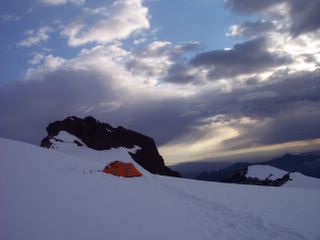
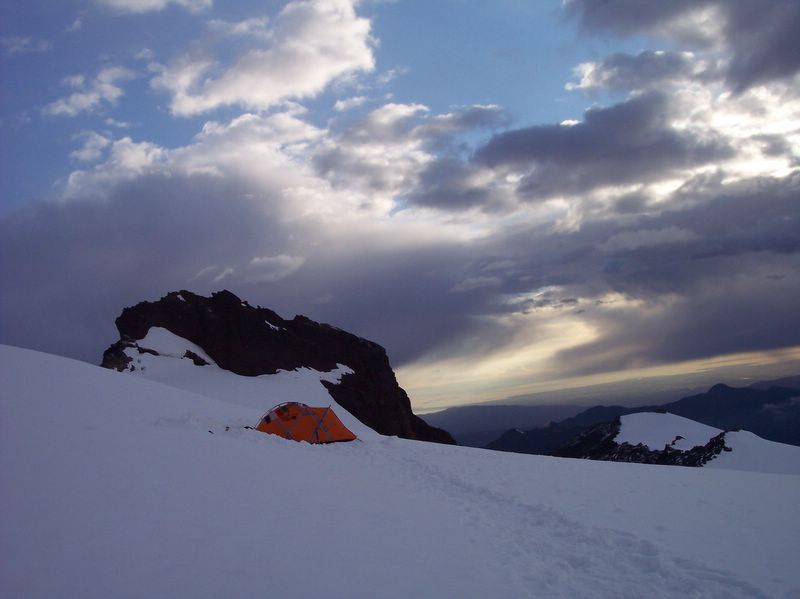
One dark night, while camping on a Mount Baker's Coleman Glacier, I peered out of my tent to see a full moon and an approaching snow storm. It was so cold I had been trying to sleep fully clothed, including heavy boots and with a backpack under my legs to stay warm.
I could never have imagined that 600 years earlier in 1473, a 15th century Japanese poet had so perfectly captured my frozen moment in time.
This poet-priest-scholar was named Sōgi; the poem is called Over the Ice, it is only two verses in length, and it contains a total of 31 syllables.
The poem's images are fresh.
My camp site on the Coleman glacier is shown below.
Please click on picture;
Sunset At Highcamp
Over the Ice poem may be found in an article called Three Poets at Yuyama; Sogi and Yuyama Sangin Hyakuin.
I could never have imagined that 600 years earlier in 1473, a 15th century Japanese poet had so perfectly captured my frozen moment in time.
This poet-priest-scholar was named Sōgi; the poem is called Over the Ice, it is only two verses in length, and it contains a total of 31 syllables.
The poem's images are fresh.
| "Over the Ice" | Poet: Sōgi |
|---|---|
| English translation by: Stephen D. Carter | Japanese |
| Over the ice A cold wind blows. In the sky's expanse Clouds speed past the moon On a clear night | Kōri no ue o Kaze wa yuku nari Kumo hayaki Tsuki no ōzora Sayuru yo ni |
My camp site on the Coleman glacier is shown below.
Please click on picture;
Sunset At Highcamp

Over the Ice poem may be found in an article called Three Poets at Yuyama; Sogi and Yuyama Sangin Hyakuin.
Sunday, February 14, 2010
Fisherman
Chinese calligraphy scholar P. Wong today suggested I read a poem entitled Fisherman, written by Chinese poet LIU ZONGYUAN (773-819). He is also known as LIU TSUNG-YUAN.
I found Liu's biography here along with fine translations of some of his poems. In his poem Fisherman, Liu's imagery paints a beautiful landscape very similar to the Japanese poem Minase Sangin Hyakuin. I find Fisherman to be another masterful poem; simple, yet beautiful.
The Fisherman
A fisherman spends the night under West Rock,
pails clear river water and burns bamboo.
Smoke vanishes, sun rises and no one is seen.
The oar-sound turns mountains and water green.
Floating the central current, he turns to gaze at sky
above rock where mindless clouds chase each other.
I found Liu's biography here along with fine translations of some of his poems. In his poem Fisherman, Liu's imagery paints a beautiful landscape very similar to the Japanese poem Minase Sangin Hyakuin. I find Fisherman to be another masterful poem; simple, yet beautiful.
The Fisherman
A fisherman spends the night under West Rock,
pails clear river water and burns bamboo.
Smoke vanishes, sun rises and no one is seen.
The oar-sound turns mountains and water green.
Floating the central current, he turns to gaze at sky
above rock where mindless clouds chase each other.
A Poignant Verse and Obsession with Minase Sankin Hyukuin
Hi all,
I hope you read and enjoyed my last post. That post celebrated my reading of the first 8 verses from the classic japanese poem Minase Sankin Hyakuin.
So how did I get hooked on this poem?
Well, in some obscure document, while I was browsing through the SAAM library archives, I discovered the single most poignant verse I have ever set eyes upon - it conveyed this sad emotion using only 31 syllables.
Here is the verse:
The verse has greatest emotional impact (to me) when read in isolation from the larger poem - the context is different, and this verse inspired my search for all 100 verses of Minase Sankin Hyakuin, eight of which I posted yesterday.
I think I have all 100 verses now, after possibly finding them in a recent visit to the SAAM library, so you may be seeing more Minase Sankin Hyakuin blog posts in the future :-).
I hope you read and enjoyed my last post. That post celebrated my reading of the first 8 verses from the classic japanese poem Minase Sankin Hyakuin.
So how did I get hooked on this poem?
Well, in some obscure document, while I was browsing through the SAAM library archives, I discovered the single most poignant verse I have ever set eyes upon - it conveyed this sad emotion using only 31 syllables.
Here is the verse:
| Minase Sangin A Poignant Verse | Poets: Sogi, Shohaku, Socho |
|---|---|
| English translation by: Nobuyuki Yasa | Japanese |
In a sorrowful voice A cricket is heard singing Beneath the withering grass. I paid a call to a friend of mine, Taking a desolate lane by the hedge. | nakumushi no kokoro motonaku kusa karete kakine o toeba arawanaru michi |
The verse has greatest emotional impact (to me) when read in isolation from the larger poem - the context is different, and this verse inspired my search for all 100 verses of Minase Sankin Hyakuin, eight of which I posted yesterday.
I think I have all 100 verses now, after possibly finding them in a recent visit to the SAAM library, so you may be seeing more Minase Sankin Hyakuin blog posts in the future :-).
Friday, February 12, 2010
Minase Sangin Hyakuin
I just discovered the opening portion of this beautiful, picturesque renga poem created in Minase, Japan on January 1488 by three famous poets--Sogi, Shohaku, and Socho (see poem at bottom of page).
The poem's hokku, or opening verse, was created by Sogi who was by far the greatest of the three master poets.
As the three poets gathered together in a room, they each took turns creating successive poem verses, carefully linking the verses together so they flowed into one another, creating in words the vision of a beautiful landscape painting. The poem was improvised on-the-spot!
Sogi created the first 17 syllable verse (first 3 lines in japanese), then Shohaku created the next 14 syllable verse (next 2 lines), and finally Socho created the third 17 syllable verse (next 3 lines), and so on...
Please enjoy Minase Sangin's first eight verses shown below:
It was nice wasn't it?
As I read the poem, this image formed in my mind:
There is a snowy mountain, its summit poking up above the mist. There is a river flowing down, out of the mountain, through a plum orchard, and past a village.
Still in early morning light, there is a moon behind the clouds, a man slowly, quietly rowing a boat, and throughout all of this, there are only the sounds of an oar dipping into the water, crickets chirping, the river, and the breeze.
I discovered this poem in the introduction to The Narrow Road to the Deep North - it was elegantly translated from japanese into english by Nobuyuki Yuasa.
I found a good explanation of renga poems in Minase Sangin - An Introduction to Renga , but the translation provided there was not as enjoyable - possibly too literal..
The poem's hokku, or opening verse, was created by Sogi who was by far the greatest of the three master poets.
As the three poets gathered together in a room, they each took turns creating successive poem verses, carefully linking the verses together so they flowed into one another, creating in words the vision of a beautiful landscape painting. The poem was improvised on-the-spot!
Sogi created the first 17 syllable verse (first 3 lines in japanese), then Shohaku created the next 14 syllable verse (next 2 lines), and finally Socho created the third 17 syllable verse (next 3 lines), and so on...
Please enjoy Minase Sangin's first eight verses shown below:
| Minase Sangin 1st 8 verses | Poets: Sogi, Shohaku, Socho |
|---|---|
| English translation by: Nobuyuki Yasa | Japanese |
| Snow-capped as they are The gentle slopes of the mountains Fade into the hazy mist at twilight on a Spring day. The river descends far & distant Plum-fragrance filling the village. In a soft river breeze stands a single willow tree Fresh in Spring colour At early dawn every push of the oar Is audible from a passing boat. There must be a moon Dying in the morning sky Wrapped in heavy fog The ground is covered with frost, The Autumn is drawing to a close. In a sorrowful voice A cricket is heard singing Beneath the withering grass. I paid a call to a friend of mine, Taking a desolate lane by the hedge. | yukinagara (5) yamamotokasumyu (7) yubekana (5) yuku mizu tooku (7) ume niou sato (7) kawakaze ni (5) hitomura yanagi (7) harumiete (5) fune sasu oto mo (7) shiruki akegata (7) tsyuukiyanao (5) kiriwataru yo ni (7) nokoru ram (5) shimo oku nohara (7) akiwa kure ni keri (8) nakumushi no (5) kokoro motonaku (7) kusa karete (5) kakine o toeba (7) arawanaru michi (7) |
It was nice wasn't it?
As I read the poem, this image formed in my mind:
There is a snowy mountain, its summit poking up above the mist. There is a river flowing down, out of the mountain, through a plum orchard, and past a village.
Still in early morning light, there is a moon behind the clouds, a man slowly, quietly rowing a boat, and throughout all of this, there are only the sounds of an oar dipping into the water, crickets chirping, the river, and the breeze.
I discovered this poem in the introduction to The Narrow Road to the Deep North - it was elegantly translated from japanese into english by Nobuyuki Yuasa.
I found a good explanation of renga poems in Minase Sangin - An Introduction to Renga , but the translation provided there was not as enjoyable - possibly too literal..
Saturday, January 23, 2010
Rocks Scattered Here and There
This week I have discovered for myself a wonderful connection between an 18th century Japanese poet, Yosa Buson(与謝蕪村), an 11th century poet/ philosopher Su Shih (蘇軾), and the 11th century novelist Murasaki Shikibu (紫 式 部).
Murasaki Shikibu wrote Genji Monogatari, a 54 chapter novel, possibly the first novel of its kind ever written (~1000 A.D.), and certainly the single most important piece of classical Japanese literature to this day.
And…for a thousand years, Japanese renga and haikai poets have borrowed phrases from, and been inspired by the prose poems Murasaki wrote into Genji Monogatari. In fact, her novel was a revered store-house of poems often consulted by master Japanese poets.
Seven hundred years later, Buson was one such poet inspired by Genji Monogatari.
But…Buson was also inspired by Su Shih’s Prose Poems on the Red Cliffs, written 700 years before Buson picked-up a writing brush.
The Su Shih passage Buson liked most was:
“The mountains rise high,
the moon looks small,
and water falls between the rocks”.
Reading this passage very slowly, I only then become aware of how much I love the imagery Su Shih conjures in this brief poem. I am a mountaineer and that poem simply and beautifully captures a scenic moment in time, a moment I have experienced many times while climbing in the Olympic Mountain Range of the Great Northwest.
Buson had penned a very similar poem, Rocks Scattered Here and There, actually a haiku painting, many years before reading Su Shih. Please enjoy his poem and haiku painting shown below.
Title: Rocks Scattered Here and There
Written By 立圃書 (Yosa Buson)
Willow leaves are gone,
the fresh brook has now run dry--
rocks scattered here and there.
Yanagi chiri
shimizu kare ishi
tokorodokoro
Picture is Buson Haiga for Rocks Scattered Here and There
 References I relied upon on for this article were:
The Sights and Sounds of Red Cliffs: On Reading Su Shi
The poet-painters: Buson and his followers
Haiku Painting
The Tale of Genji
Murasaki Shikibu wrote Genji Monogatari, a 54 chapter novel, possibly the first novel of its kind ever written (~1000 A.D.), and certainly the single most important piece of classical Japanese literature to this day.
And…for a thousand years, Japanese renga and haikai poets have borrowed phrases from, and been inspired by the prose poems Murasaki wrote into Genji Monogatari. In fact, her novel was a revered store-house of poems often consulted by master Japanese poets.
Seven hundred years later, Buson was one such poet inspired by Genji Monogatari.
But…Buson was also inspired by Su Shih’s Prose Poems on the Red Cliffs, written 700 years before Buson picked-up a writing brush.
The Su Shih passage Buson liked most was:
“The mountains rise high,
the moon looks small,
and water falls between the rocks”.
Reading this passage very slowly, I only then become aware of how much I love the imagery Su Shih conjures in this brief poem. I am a mountaineer and that poem simply and beautifully captures a scenic moment in time, a moment I have experienced many times while climbing in the Olympic Mountain Range of the Great Northwest.
Buson had penned a very similar poem, Rocks Scattered Here and There, actually a haiku painting, many years before reading Su Shih. Please enjoy his poem and haiku painting shown below.
Title: Rocks Scattered Here and There
Written By 立圃書 (Yosa Buson)
Willow leaves are gone,
the fresh brook has now run dry--
rocks scattered here and there.
Yanagi chiri
shimizu kare ishi
tokorodokoro
Picture is Buson Haiga for Rocks Scattered Here and There

The Sights and Sounds of Red Cliffs: On Reading Su Shi
The poet-painters: Buson and his followers
Haiku Painting
The Tale of Genji
Sunday, January 3, 2010
Ducks in Reeds
I believe “Ducks in Reeds” is beautiful in its simplicity and minimalism - it has started me on a path to exploring more of the Japanese master painters/ poets from the Edo era.
Title: Ducks in Reeds
Written By 立圃書 (Ryuuho)
Haiku Poem:
Within the withered reeds
the turquoise feathers
of wild ducks
Kare-ashi no
Naka ni aoba no
Magamo kana
Calligraphy is:
枯葦の 中に青羽の 真鴨
For me, the poem lends a peaceful dynamic to the painting. I can almost feel the quiet isolation of ducks feeding on minnows, as the stream slowly drifts through the marshy islands and a gentle wind bends the reeds.
As I admire the painting, I notice that the calligraphy in the upper left of the painting frames a curving space in the river stream. From this curve extends three small, marsh- like islands stretching across the center of the painting; notice the small black dots on each island are ducks grazing there. In the foreground near the bottom are two detailed pictures of the ducks.

This poem, along with its translation and depiction are published in the excellent book :
Haiku and Haiga: Moments in Word and Image
I invite your comments on this work of art.
Title: Ducks in Reeds
Written By 立圃書 (Ryuuho)
Haiku Poem:
Within the withered reeds
the turquoise feathers
of wild ducks
Kare-ashi no
Naka ni aoba no
Magamo kana
Calligraphy is:
枯葦の 中に青羽の 真鴨
For me, the poem lends a peaceful dynamic to the painting. I can almost feel the quiet isolation of ducks feeding on minnows, as the stream slowly drifts through the marshy islands and a gentle wind bends the reeds.
As I admire the painting, I notice that the calligraphy in the upper left of the painting frames a curving space in the river stream. From this curve extends three small, marsh- like islands stretching across the center of the painting; notice the small black dots on each island are ducks grazing there. In the foreground near the bottom are two detailed pictures of the ducks.

Second Translation:
Withered reed
within -- blue feather
wild duckwithin -- blue feather
This poem, along with its translation and depiction are published in the excellent book :
Haiku and Haiga: Moments in Word and Image
I invite your comments on this work of art.
Subscribe to:
Posts (Atom)