Save for his thin voice
The motionless heron
Is but a drift of snow.
...Sōkan (1465 - 1554)
Japanese Impressions
Saturday, February 19, 2011


A Fallen Petal - by Arakida Moritake
A fallen petal
Rises to the branch:
Ah, a butterfly!
by Arakida Moritake
Passage excerpted from here
Rises to the branch:
Ah, a butterfly!
by Arakida Moritake
Passage excerpted from here
Dark Passage
Passage into dark
mountains over which the moon
presides so brilliantly....
Not seeing it i'd have missed
this passage into my own past.
by Poet-monk Saigyō Hōshi

mountains over which the moon
presides so brilliantly....
Not seeing it i'd have missed
this passage into my own past.
by Poet-monk Saigyō Hōshi
Mt Myojingatake in May - Notes to myself after hike.
Great mountain.
Great hike.
It was warm.
I was drenched in rain showers.
My cell phone battery was dead at the mountain's summit.
I was dry and muddy at end of hike.
Took the 2 plus hour train rides back looking like a vagabond but feeling great.
Somehow managed to get a sunburn (not too bad).
Hiked from Sengoku, over mountain, to Daiyuzan.
Please click on flower to see best picture.
This flower was beside the trail - I took the picture while the rain was still falling.
Trailside Mountain Flower

CHU CH'EN VILLAGE (A.D. 811)
Through this beautiful prose, Po Chu-i writes of simple villagers living an ideal, uncomplicated life.
Title: CHU CH'EN VILLAGE (A.D. 811)
Poet: Po Chu-i
More Translations From The Chinese
"In Hsii-chou, in the District of Ku-feng
There lies a village whose name is Chu-ch'en ―
A hundred miles away from the county-town,
Amid fields of hemp and green of mulberry-trees.
Click, click goes the sound of the spinning-wheel;
Mules and oxen pack the village-streets.
The girls go drawing the water from the brook;
The men go gathering fire-wood on the hill.
So far from the town Government affairs are few;
So deep in the hills, man's ways are simple.
Though they have wealth, they do not traffic with it;
Though they reach the age, they do not enter the Army.
Each family keeps to its village trade;
Grey-headed, they have never left the gates.
Alive, they are the people of Ch'en Village;
Dead, they become the dust of Ch'en Village.
Out in the fields old men and young
Gaze gladly, each in the other's face.
In the whole village there are only two clans;
Age after age Chus have married Ch'ens.
Near or distant, they have kinsmen in every house;
Young or old, they have friends
wherever they go.
On white wine and roasted fowl they fare
At joyful meetings more than " once a week."
While they are alive, they have no distant partings;
To choose a wife they go to a neighbour's house.
When they are dead,― no distant burial;
Round the village graves lie thick.
They are not troubled either about life or death;
They have no anguish either of body or soul.
And so it happens that they live to a ripe age
And great-great-grandsons are often seen."
Saturday, January 29, 2011
Quiet Despair
In my solitude,
I sadly wonder what to do,
But the only reply
Is the rustling
Of the reeds before me.
Hitori shite
Ika ni semashi to
Wabitsureba
Soyo tomo mae no
Ogi no kotauru.
Excerpt from: Kon- jaku Monogatari.
It is also the basis for the noh play Ashikari.
Part of Yamato Monogatari.
I sadly wonder what to do,
But the only reply
Is the rustling
Of the reeds before me.
Hitori shite
Ika ni semashi to
Wabitsureba
Soyo tomo mae no
Ogi no kotauru.
Excerpt from: Kon- jaku Monogatari.
It is also the basis for the noh play Ashikari.
Part of Yamato Monogatari.
Wednesday, January 5, 2011
THE LETTER by Po Chu-i [A.D. 81 ]
Another gem from Po; he has such a great sense of humor and rhythm. Po wrote THE LETTER soon after becoming separated from his exhiled best friend.
THE LETTER
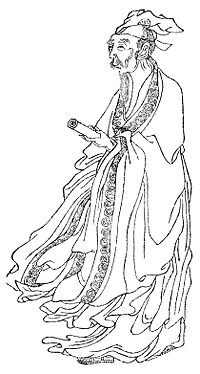
by Po Chu-i [A.D. 81 ]
"A knocking on the door sounded 'Doong, doong!'
They came and told me a messenger from Shang-chou
had brought a letter, a single scroll from you!
Up from my pillow I suddenly sprang out of bed
and threw on my clothes, all topsy-turvy.
I undid the knot and saw the letter within;
a single sheet with thirteen lines of writing.
At the top it told the sorrows of an exile's heart;
at the bottom it described the pains of separation.
The sorrows and pains took up so much space
There was no room left to talk about the weather! "
I excerpted this passage from "The Letter".
Reference: Waley, A. D., & Chu-I, P. (January 01, 1917). Thirty-Eight Poems by Po Chu-I. Bulletin of the School of Oriental Studies, London Institution, 1, 1, 53-78.
Po link: http://en.wikipedia.org/wiki/Po_Chu-i
Saturday, December 11, 2010
The Great Summons
THE GREAT SUMMONS
---Chu Yuan (褚淵) (435-482)
"When Chu Yuan had been exiled from the Court for nine years, he became so despondent that he feared his soul would part from his body and he would die. It was then that he made the poem called " The Great Summons," calling upon his soul not to leave him:
"In those dark caves where Winter lurketh
Hide not, my Soul! 0 Soul come back again! 0, do not stray!
0 Soul come back again and go not east or west, or north
or south!
For to the East a mighty water drowneth Earth's other shore;
Tossed on its waves and heaving with its tides
The hornless Dragon of the Ocean rideth: Clouds gather low and fogs enfold the sea
And gleaming ice drifts past.
0 Soul go not to the East,
To the silent Valley of Sunrise!
0 Soul go not to the South
Where mile on mile the earth is burnt away
And poisonous serpents slither through the flames;
Where on precipitous paths or in deep woods
Tigers and leopards prowl,
And water-scorpions wait;
Where the king-python rears his giant head.
0 Soul, go not to the South
Where the three-footed tortoise spits disease!
0 Soul go not to the West
Where level wastes of sand stretch on and on;
And demons rage, swine-headed, hairy-skinned,
With bulging eyes;
Who in wild laughter gnash projecting fangs.
0 Soul go not to the West
Where many perils wait!
0 Soul go not to the North,
To the Lame Dragon's frozen peaks;
Where trees and grasses dare not grow;
Where a river runs too wide to cross
And too deep to plumb,
And the sky is white with snow
And the cold cuts and kills.
0 Soul seek not to fill
The treacherous voids of the north!
0 Soul come back to idleness and peace.
In quietude enjoy
The lands of Ching and Ch'u.
There work your will and follow your desire
Till sorrow is forgot,
And carelessness shall bring you length of days.
0 Soul come back to joys beyond all telling!
Where thirty cubits high at harvest-time
The corn is stacked;
Where pies are cooked of millet and bearded-maize.
Guests watch the steaming bowls
And sniff the pungency of peppered herbs.
The cunning cook adds slices of bird-flesh,
Pigeon and yellow-heron and black-crane.
They taste the badger-stew.
0 Soul come back to where the good are praised!
Like the sun shining over the four seas
Shall be the reputation of our King;
His deeds, matched only in Heaven, shall repair
The wrongs endured by every tribe of men,—
Northward to Yu and southward to Annam,
To the Sheep's Gut Mountain and the Eastern Seas.
0 Soul come back to where the wise are sought!
Behold the glorious virtues of our King
Triumphant, terrible;
Behold with solemn faces in the Hall
The Three Grand Ministers walk up and down,—
None chosen for the post save landed-lords
0 Soul come back to where men honour still
The name of the Three Kings."
Note: I have abridged this prose poem for my own satisfaction: the complete version can be viewed/ downloaded at:
More Translations From The Chinese
Friday, November 26, 2010
FISHING IN THE WEI RIVER
Today I share prose composed by Po Chu-i (see his pic); he writes of a most carefree of fishermen.
Now, his light hearted story of this fisherman was written in China over1400 years ago, yet it describes me today!
 FISHING IN THE WEI RIVER
Now, his light hearted story of this fisherman was written in China over1400 years ago, yet it describes me today!
FISHING IN THE WEI RIVERby Po Chu-i (772 - 846)
composed ~ A.D. 811"In waters still as a burnished mirror's face,
In the depths of Wei, carp and grayling swim.Idly I come with my bamboo fishing-rod
And hang my hook by the banks of Wei stream.
A gentle wind blows on my fishing-gear
Softly shaking my ten feet of line.
Though my body sits waiting for fish to come,
My heart has wandered to the Land of Nothingness.
Long ago a white-headed man (note 1)
Also fished at the same river's side;
A hooker of men, not a hooker of fish,
At seventy years, he caught Wen Wang. (note 1)
But , when I come to cast my hook in the stream,
Have no thought either of fish or men.
Lacking the skill to capture either prey,
I can only bask in the autumn water's light.
When I tire of this, my fishing also stops;
I go to my home and drink my cup of wine.
Note 1: Reference is made to the Sage T'aiJkung who sat still till he was seventy, apparently fishing, but really waiting for a Prince who would employ him. At last Wen Wang, Prince of Chou, happened to come that way and at once made him his counsellor."
Reference: Waley, A., & Bai, J. (1919). More translations from the Chinese. New York: Knopf.
.
Sunday, November 21, 2010
First Snowfall
As I glance out of my window, I find that it is snowing; our first snowfall has arrived. With the light now diminishing, I begin to enjoy the quiet solitude within my home; then I read this passage from Yamato Monogatari and melancholy settles.
"In my solitude,
I sadly wonder what to do,
But the only reply
Is the rustling
Of the reeds before me."
"Hitori shite
Ika ni semashi to
Wabitsureba
Soyo tomo mae no
Ogi no kotauru."
Paul
"In my solitude,
I sadly wonder what to do,
But the only reply
Is the rustling
Of the reeds before me."
"Hitori shite
Ika ni semashi to
Wabitsureba
Soyo tomo mae no
Ogi no kotauru."
Paul
Entering the Emporer's Domain
At a wayside Inn, while lying on a wizard's pillow, the young man (Rosei) quickly falls asleep; he begins dreaming of his future, of being summoned to the Emperor’s palace to begin reigning as the new King. Rosei describes the spectacular sight which greets him as his bejeweled carriage approaches the palace gates.
"A courtyard strewn
With golden and silver sand;
And they that at the four sides
Pass through the jeweled door are canopied
With a crown of woven light."
A pretty fresh image, wouldn't you agree?
===============================
Note: Poem included in Kantan Nō Play by Zeami.
Trans: Arthur Waley
"A courtyard strewn
With golden and silver sand;
And they that at the four sides
Pass through the jeweled door are canopied
With a crown of woven light."
A pretty fresh image, wouldn't you agree?
===============================
Note: Poem included in Kantan Nō Play by Zeami.
Trans: Arthur Waley
Friday, November 19, 2010
Song of the Peach Tree Spring (with unfortunate appendix)
Song of the Peach Tree Spring
"My fishing boat sails the river. I love spring in the mountains.
Peach blossoms crowd the river on both banks as far as sight.
Sitting in the boat, I look at red trees and forget how far I’ve come.
Drifting to the green river’s end, I see no one.
Hidden paths wind into the mountain’s mouth.
Suddenly the hills open into a plain
and I see a distant mingling of trees and clouds.
Then coming near I make out houses, bamboo groves, and flowers
where woodcutters still have names from Han times
and people wear Qin dynasty clothing.
They used to live where I do, at Wuling Spring,
but now they cultivate rice and gardens beyond the real world.
Clarity of the moon brings quiet to windows under the pines.
Chickens and dogs riot when sun rises out of clouds.
Shocked to see an outsider, the crowd sticks to me,
Competing to drag me to their homes and ask about their native places.
At daybreak in the alleys they sweep flowers from their doorways.
By dusk woodcutters and fisherman return, floating in on the waves.
They came here to escape the chaotic world.
Deathless now, they have no hunger to return.
Amid these gorges, what do they know of the world?
In our illusion we see only empty clouds and mountain.
I don’t know that paradise is hard to find,
and my heart of dust still longs for home.
Leaving it all, I can’t guess how many mountains and waters lie behind me,
and am haunted by an obsession to return.
I was sure I could find my way back on the secret paths again.
How could I know the mountains and ravines would change?
I remember only going deep into the hills.
At times the green river touched cloud forests.
With spring, peach blossom water is everywhere,
but I never find that holy source again.
by Wang Wei referring to the tale of the great poet Tao Qian.
Excerpted from “The Anchor book of Chinese Poetry”.
=================================================
Please read no further!!! What lies below will destroy the imagery created above.
=================================================
You're still reading? What follows is a really cheesy story about me, a kayak, a river marsh, and discovery.
The Unfortunate Appendix
OK, switch gears, we are back in the 21st century, that was Wang, this is me: even I have a story to tell :-). It is impossible, and probably in some countries illegal, to follow his masterpiece with my pitiful true story, but I invested some time here, so here is my Song of the River Reeds:
Song of the River Reeds
Once, six or seven years ago on a hot summer day, I was driving along a stretch of Conneticut shoreline when unexpectedly, an expansive marsh came into view. In the trunk of my rental car was an inflatable kayak, the same one I had packed for my cross country flight to the East Coast (on business of course). It was Saturday and I was looking for some adventure.
The marsh was pretty large - part of a muddy river delta containing a dense thicket of reeds, a reed forest really; the reeds must have been at least 12 feet high spanning 30 acres of black, stagnent river water. But it was more than just an impenetrable bunch of reeds, the forest had a maze of narrow water channels running thoughout. On the far side of the reed forest was a small island.
This was perfect! I pulled-over into a small parking lot near an old boat launch and within 15 minutes I was paddling my kayak into the reeds.
It was so peaceful in the reed maze. Even so, I felt as though anything could be hidden just around the next blind corner. The anticipation of discovering some hidden alcove was, well...it was quietly exciting.
Then it happened - as I steered into the reed tunnel to my left, a family of swans crossed in front of me, they were not more than 20 feet away!
The story continues but I'll spare you. At least there was a river and something undiscovered (the swans).
Trust me when I say I deleted this twice before pasting it back in.
Monday, November 15, 2010
My Path to Learning Japanese Culture (Pure and Simple)
Hello Tadoku Festival visitors!
My name is Paul. I live in America near Seattle, Washington. I am a Chemical Engineer and I work for a large company.
I love to learn traditional Japanese language and culture!
So you might ask me: "Paul, how did you become interested in Japanese language and culture?". Well....here is my story.
I AM an Engineer, but I also am a musician, mountain climber, and I write English language engineering books for workers.
I have played American guitar for many years. I play "Blues" style music. I learned the music made by old masters who lived in the 1920s. Music of the old masters was pure and simple. This is the best music to learn.
In January 2008 I came to Japan for 1 year to work for my company. I worked in Yokosuka and on weekends I traveled to Yokohama, Tokyo, Hakone, and many other places.
While still in Japan I wanted to learn to play a traditional Japanese musical instrument. I found koto teacher Hiroko Kodama in Yokohama and she began to teach me lessons for Ikuta-ryu koto music. I found shamisen teacher Makoto Nishimura in Setagaya-ku, Tokyo and she began to teach me lessons for Nagauta shamisen music. This music is pure and simple and the best music to learn (for me).
Next, I wanted to speak to my Japanese music teachers so I needed to learn Japanese language - this was very difficult for me. I began taking Kumon Japanese language writing lessons in a classroom with little children; this was a good beginning. I also bought many "Learn Japanese Language" books. Lessons in these books were very difficult and tedious. I also tried to read Japanese language Manga, watch anime, and watch old Japanese movies (Toshiro Mifune). Of course the old Mifune-san movies are the best!
Still, there were so many words to learn and it seemed not enjoyable.
Then I asked myself, "What is simple, pure, taught by old masters, and is written in Japanese language?".
Haiku! Only 17 hiragana characters. Waka! Only 31 hiragana characters.
The haiku and waka poetry are beautiful and are a pleasure to learn. The Japanese poetry always includes seasons of nature and it sometimes reminds me of the mountains I climb.
I tried to translate the haiku and waka from Japanese into English. I read many translations written by famous scholars. I began to read classical Japanese literature like Genji Monogatari (in English) since it has poems. Since these are ancient poems, I began to learn about Heian period art and culture.
Then I visited a Japanese museum in Seattle and discovered haiga. The haiga was wonderful! Haiga combined three beautiful arts: poetry, painting, and calligraphy.
Today the Japanese language is still very difficult for me to read. But....learning simple, beautiful Japanese music, art, and poetry has made my Path to learning the Japanese language rewarding and enjoyable!
Thank you for allowing me to participate in this Tadoku festival from so far away in America. Special thanks to my friend Mrs. Malone for inviting me to the festival.
Respectfully,
Paul
PS, I invite you to visit my blogs and to visit me on Facebook; here are the links:
http://haigaobsession.blogspot.com/
http://newsfrompaul.blogspot.com/
http://paulonjapan.blogspot.com/
http://www.youtube.com/user/AcousticSummit
http://www.facebook.com/paulwilliams4
Monday, October 25, 2010
Leaves Scattering - Finding One's Way
In 1162 Saigyō prepared to depart for a distant pilgrimage to Shikoku, a journey he would embark upon alone. Disheartened, he sought a return to solitude, far away from the frenzy of the capital.
When the Shirakawa Major Counselor heard of the wandering monk’s eminent departure, he sent Saigyō this note:
“Accompanying
tree leaves on the peak,
swept by storms
where in your driftings
will your heart lead you?”
Saigyō replied:
“At random
fall the tree leaves
in the blowing wind.
How is one to know
where they will scatter?”
Often times I too have felt as Saigyō.
One bright summer in August 2005 I too was in search of solace. For my journey I would hike up through a very steep ravine in the Olympic wilderness. From the bottom of the ravine I would gain a high rocky ridge then, scrambling up the ridge, further gain a summit peak known as Tyler Peak.
Well….I did summit the mountain's peak – on top it was so tranquil; the scenery was of unparalleled beauty.
Finally though I had to leave, retrace my steps, descend back into the ravine, and return home.
Retrace my steps? Now which path had I taken? All paths looked the same and they were radiating in all directions. The terrain was so steep and the sun was now going down quickly, too quickly.
I could go on describing my harrowing return from the wilderness area, but I’ll only add that I returned home at 3 AM the next day, totally exhausted, severely dehydrated, and just a little wiser.
I came to embrace the importance of knowing exactly where the leaves will scatter.
Waka translations made by Gustav Heldt in “Saigyō’s Traveling Tale – A Translation of Saigyō Monogatari”.
Subscribe to:
Posts (Atom)